Mako Lomadze
By Ana Mikatadze
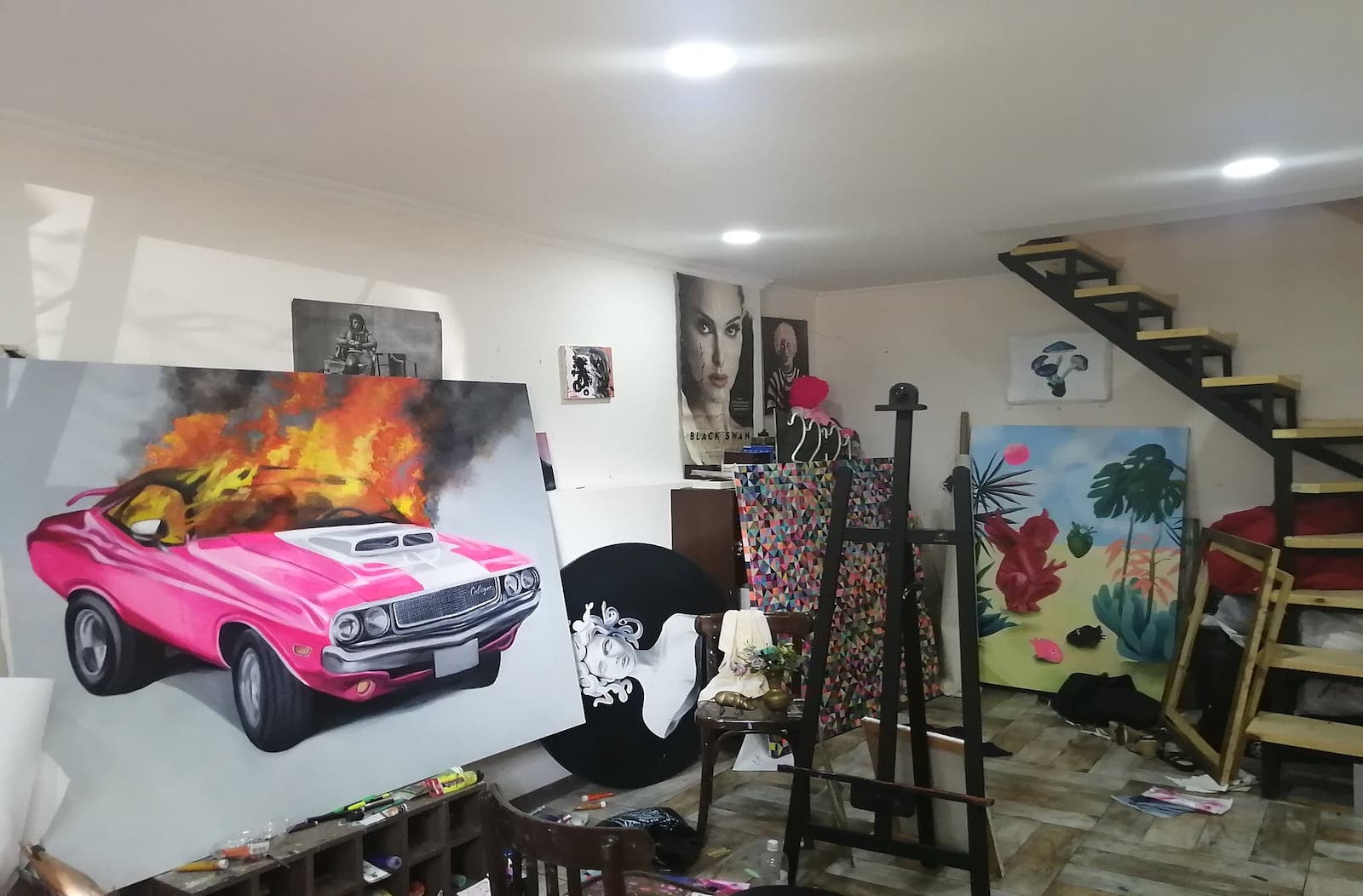
I met Mako Lomadze in her studio for our conversation. Paintings were scattered across every corner, and the atmosphere felt exactly right for the space, filled with positive, creative energy. Sitting there, surrounded by her work, the interview felt more like a quiet conversation than a formal meeting.
When did you start painting?
Mako: I’ve been painting since I was two years old. For some reason, my very first drawing was a spider. I started painting with my left hand, which was considered a problem back then, but I was lucky. My director was left-handed too, so he didn’t mind. I’m really grateful for that, because I don’t know if I would have continued painting if they had tried to force me to use my right hand.
When I was little, I didn’t want to do anything except paint, and adults were often angry with me because of it. When I started studying at an art gymnasium, I had two hours of painting classes, and that was my only real pleasure. I didn’t care much about school or ballet. I always knew I would get my bachelor’s degree in painting, and that’s exactly what I did. I completed my master’s as well, and now I work as a freelancer and participate in exhibitions.
What do you paint, and where do you find inspiration?
Mako: Everything around me inspires me. This isn’t just a profession, it’s my life. I’m inspired by emotions and everyday experiences. Dreams probably play the biggest role. I may not remember a dream clearly, but the emotions I wake up with stay with me, and they’re very important for my work. I usually try to put them onto the canvas the next day.
How would you describe your style?
Mako: Mostly realism, I think, but I’m not sure. I change styles often. Lately, I’ve been more drawn to surrealism. I don’t really have one fixed style yet, I’m still searching. But realism is probably what I return to the most.
Do you feel there is room for self-realization in Tbilisi?
Mako: I don’t think Tbilisi offers a very high level of opportunity in that sense, and it’s quite difficult to realize yourself here. Maybe I’m wrong, but it often feels like you need to work twice as hard compared to other cities. We face many challenges and are still developing as a country, which is why I really want to study abroad. Traveling is essential for an artist. Still, I don’t want to leave forever. I know I’ll come back after some time.
Where do you think Tbilisi stands on the development scale?
Mako: There’s a big gap between Tbilisi and cities in more developed countries. You can feel that we’re slowly trying to catch up. There are many interesting projects, but we’re still far behind. The same applies to my field. Selling art here can’t really be compared to international standards. That said, I’ve been working as a painter for over eight years, and things have improved. I see more art spaces opening, and that really excites me.
How do you see life in general? War or peace?
Mako: I’d say war for peace. I’ve had periods when I didn’t do anything at all, and that was tragic for me. Not creating kills me, and I think it affects everyone the same way. I believe in peace, but given the world we live in, it’s rarely possible without fighting for it.
Do you do anything besides painting?
Mako: Sometimes I teach students in my studio. Mostly adults who already understand the basics and want to refine their skills. While we work, I talk to them about the history of painting. I strongly believe that learning how to draw requires knowing theory and the general history of art as well.
Have you had any particularly memorable exhibitions?
Mako: Yes, one stands out. In 2016, while I was finishing my master’s degree, there was a competition announced for a project called Personal Structures under the Venice Biennale. Ten students were selected, and I was one of them. It was a different format, though. Instead of paintings, I presented an installation called Metamorphosis. We went to the Biennale and spent a few magical days there. The exhibition lasted six months, but we stayed for the first ten days and met artists from all over the world. I grew immensely during that time. It also helped my work gain more visibility, as many people shared it on social media. I can honestly say it was one of the most important periods of my life.
Do you currently have work on display?
Mako: I had a solo exhibition at the Gamrekeli Gallery not long ago, and I’m preparing for another one by the end of this year. Right now, some of my works are on display at ArtTent until the end of August. It’s a new, innovative space in Mtatsminda Park featuring works by 61 artists from different generations as part of a project called The Anatomy of Existence.
What is your ultimate goal? Where would you like your work to be?
Mako: Honestly, when I imagine the future, I often see installations rather than paintings. I’d love to place them in open spaces where everyone can see them. As for paintings, I think every artist dreams of seeing their work at a Sotheby’s auction one day.

Guest Author
We're here to celebrate the spirit of our city and its dwellers and share their stories with visitors and amongst ourselves.
You May Also Like
Aison Ower
January 24, 2020
Interview With Eka Mazmishvili
February 26, 2020