Our Not So Unique Flag
Our icon is the homeland
Trust in God is our creed,
Enlightened land of plains and mounts,
Blessed by God and holy heaven.
The freedom we have learned to follow
Makes our future spirits stronger,
Morning star will rise above us
And lightens up the land between the two seas.
Glory to long-cherished freedom,
Glory to liberty!
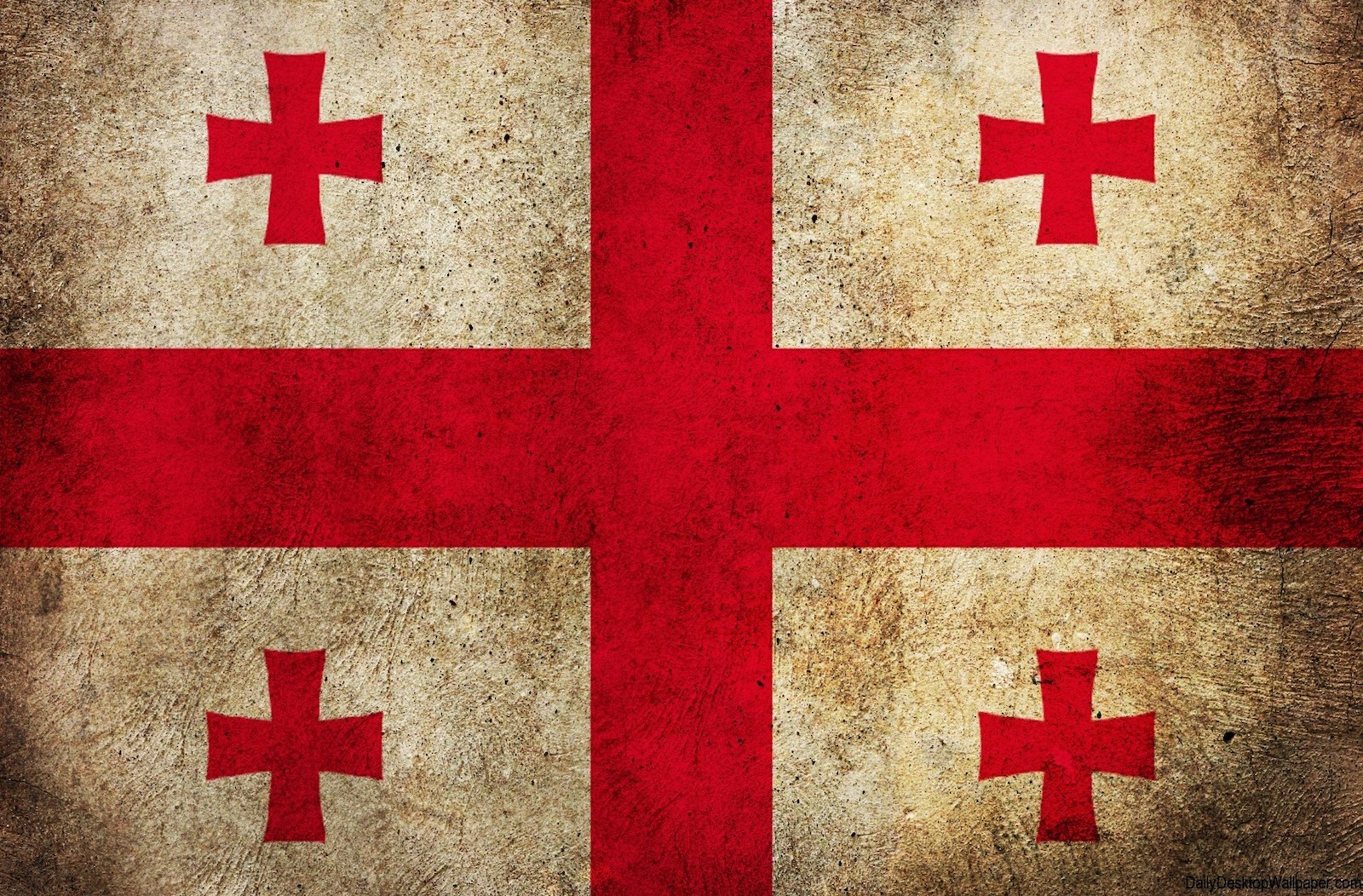
Tourist or local, you’ve almost certainly seen this flag already. You might like it, you might not (I don’t), but it’s what we’ve got, and we’re stuck with it. Still, it hasn’t always been our flag. We had different flags before annexation by the Russian Empire, a different one after breaking free from it and before being absorbed by the Soviet Union, and yet another while Georgia was part of the USSR.
There is some academic research on older flags of Georgian political entities, but none of it is based on sufficient factual evidence.
I’m not saying there was never a flag of King Tamar, King Vakhtang, or King David. I’m saying these stories are surrounded by too much uncertainty, and I don’t like uncertainty. Ironically, when we start talking about our modern flag, we’re forced to step into that same swamp.
So instead, I’ll focus on the three most recent flags, about which we have relatively solid facts: the Flag of the Democratic Republic of Georgia, the Flag of the Georgian SSR, and the current national flag.
Flag of the Democratic Republic of Georgia
Before getting to the flag, a quick recap.
In 1801, Georgia was annexed by the Russian Empire. After the Russian revolutions of 1917–1918, Georgia seized the moment and regained independence in 1918. That independence lasted barely three years. In 1921, Georgia was annexed by the Soviet Union. This short-lived period is known as the First Democratic Republic of Georgia. It’s an extremely interesting chapter of our history and deserves a separate article.
Now, the flag.
Authors: Jacob Nikoladze and Joseph Sharleman
Consultant: Ivane Javakhishvili
For comparison: the National Flag of Germany, 1918.
This was the flag of the Democratic Republic of Georgia. Anyone with a basic knowledge of German history might notice the resemblance to Germany’s national flag. Relax, this is still 1918, not Nazi Germany.
Germany was a major supporter of Georgian independence, and it’s quite possible that German political influence played a role in the choice of colors for this rather dull flag. I know many people like it, but honestly, the colors feel out of proportion. The only redeeming quality is the supposed symbolism, though even that isn’t canonical.
According to popular interpretation, black represents the dark past of the nation, white symbolizes a bright future, and crimson stands for a bloody present. This, however, is pure speculation and not supported by documentation.
While we’re at it, here’s a fun fact for those convinced that everything Georgian is entirely unique: there’s a strong possibility that the anthem of the Democratic Republic of Georgia, “Glory” (1918), was inspired by the German anthem. The melodies are almost identical.
Flag of the Georgian SSR
Now this was a real work of art.
You can clearly see how much effort and thought went into its design. Which is to say, exactly as much effort as the USSR typically invested in anything unrelated to political domination.
This was the flag of the Georgian SSR from 1922 to 1937. Then, in 1937, a sudden wave of inspiration struck some “artist,” and a new version was introduced.
On April 11, 1951, the design changed again. The background became red. In the canton, a blue field appeared with red rays surrounding a red hammer, sickle, and star. From the canton, a blue horizontal stripe extended across the flag. This design was unique among Soviet republic flags.
There is symbolism here, and it matters. In heraldry, the right and left sides of a flag have specific meanings. On this flag, the upper right section features a blue sun with full rays. In heraldry, a sun with full rays signifies death and sorrow. The same sun appears on the coat of arms of the Georgian SSR. Whoever designed these symbols almost certainly knew what they meant.
The Five-Cross Flag
Before discussing the current flag, it’s worth noting that after the collapse of the USSR in 1991, Georgia regained independence and used the same flag as in 1918–1921 until 2004. In 1991, Georgia’s first president, Zviad Gamsakhurdia, began working on a new design: a white cross on a red background. The final version, however, was adopted in 2004, when Mikheil Saakashvili came to power.
Symbolism:
The large central cross represents the Cross of Christ. The four smaller crosses represent the holy nails. Together, the flag symbolizes the Crucifixion and the Georgian nation’s bond with God.
I have an issue with this flag, but to keep things short, I’ll just say this: a country’s primary national symbol should not be a religious one.
Now, about its history.
This may upset some people with a fondness for national mythmaking, but our modern flag is not unique, and it almost certainly did not originate in Georgia.
There are claims that the five-cross flag dates back to King Vakhtang I Gorgasali, but there is no factual evidence to support this. Some texts suggest Vakhtang may have used a flag with a single cross. Another speculation credits King David the Builder with adding the four smaller crosses. Again, there’s no solid evidence.
What we do know is that this heraldic symbol was first clearly recorded in 1099 on the arms of the Crusader Godfrey of Bouillon, who bore the title Defender of the Holy Sepulcher. From then on, the symbol represented Jerusalem and, more broadly, the center of Christianity. It is known as the Jerusalem Cross, Godfrey of Bouillon’s emblem, or the Holy Sign. In heraldry, white signifies innocence, purity, and wisdom, while red stands for courage, bravery, justice, and love.
Now, here’s where Armenia enters the picture.
The oldest known depictions of the five-cross symbol are found in Armenia. Before becoming King of Jerusalem, Godfrey’s brother Baldwin of Boulogne was the first Duke of Edessa, achieved through adoption by the Armenian prince Toros of Urha. Baldwin also married Toros’s daughter, who became the first Queen of Jerusalem. This firmly ties the early Crusader leadership to Armenian political and cultural circles, especially Cilicia.
The Armenian Kingdom of Cilicia was a close ally of the Crusaders and saw itself as a Christian stronghold in the East. Europeans borrowed heavily from Armenian military architecture, art, and church design. During the First Crusade, Western armies passed through Armenian lands, forming alliances along the way. Some historians speculate that Godfrey adopted the Jerusalem Cross from Armenian iconography.
The Rubenid dynasty of Cilician Armenia was itself a branch of the Bagratid family, which had ruled both Armenia and Georgia at various times. Another theory suggests this is how the Jerusalem Cross entered Georgia in the 14th century, during the reign of George V the Brilliant.
There is also credible evidence that five-cross symbols existed as early as the 11th century, and possibly much earlier. Examples found at Geghard Monastery in Armenia are believed by many historians to date to the 4th century, though others argue they result from 13th-century restorations. Regardless, five-cross imagery is unquestionably present in Armenian churches from at least the 8th century.
So yes, I’m just saying that this symbol may well have originated in Armenia.
How it reached Georgia remains unclear. Did George V bring it directly from Jerusalem? Did Armenian iconography influence Georgian heraldry? Did the symbol only gain popularity centuries later? We simply don’t know.
P.S. Any additional sources that prove or disprove these theories are more than welcome.

Misho Zguladze
"Think of how stupid the average person is and realize half of them are stupider than that."

You May Also Like

Back To The Future
May 12, 2020
Freedom of Transportation
August 28, 2020