Losing Our Past
What Happens When We Destroy the Past?
When we destroy the past, we lose memory. And when memory is gone, so are we. Cities work the same way. Historic neighborhoods are a city’s memory, and buildings are its records.
A Many-Faceted Problem
Tbilisi’s transformation sharply clashes with its existing architectural fabric. The old city is still crumbling. Traces of the Soviet era remain, like the 18-story Bank of Georgia headquarters, while ultra-modern structures like the Peace Bridge rise against historic facades.
This transformation is anything but peaceful. It is a quiet war between old and new.
Developers squeeze high-rises into every possible space, sometimes inventing space where none existed. Meanwhile, the picturesque old town visibly decays. Walk through Tbilisi’s neighborhoods and you’ll notice that each has its own character and rhythm, all shaped by Soviet architectural legacy.
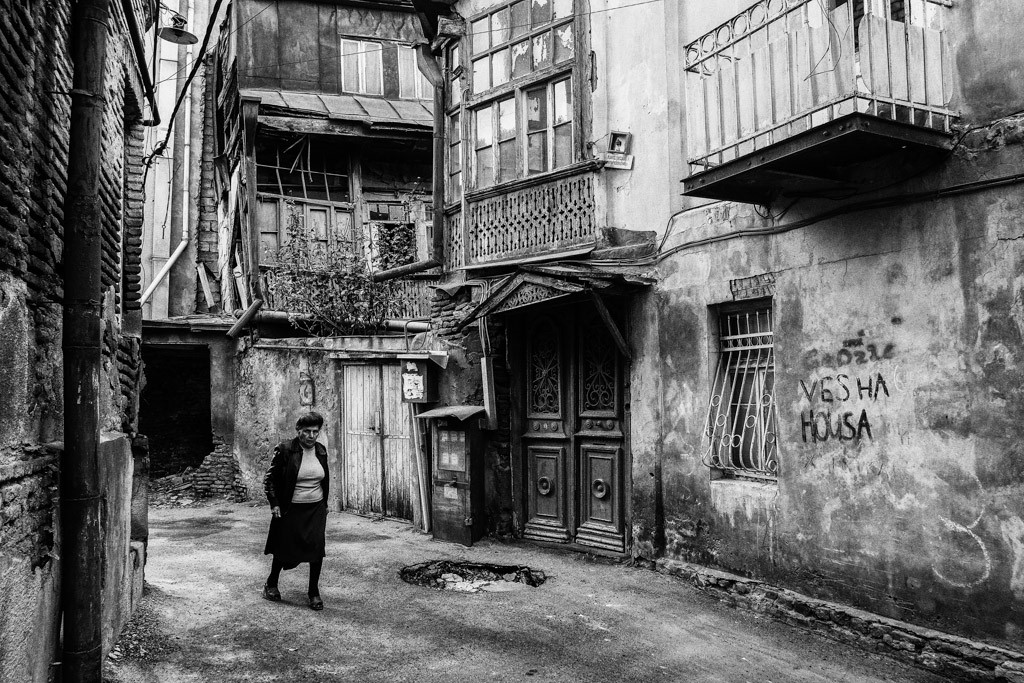
I was born and raised in Mtatsminda, an old district with narrow, tangled streets, damaged houses scarred with cracks, blind alleys, and communal courtyards. What it does not have are towering apartment blocks. What it does have is a distinct identity.
Next to it lies Sololaki, even older and the first district built according to a formal plan. Many houses there look ready to collapse at any moment. Mtatsminda is essentially a slightly newer version of Sololaki.
These fragile buildings are what make the districts captivating. Left unattended, they collapse, as many already have. Near my home stands one such building, slowly falling apart, one of dozens boarded up and unused. Because they lack official heritage status, they are largely ignored.
These neighborhoods have a style of their own. This is not only about Mtatsminda or Sololaki. Other districts suffer the same fate. I chose this example because it is closest to me.
Modernization and preservation can coexist. But destroying a historic building, or replacing it with an ill-fitting modern structure, erases the character of an entire neighborhood.
So what do we do? Let them collapse? Replace everything with glass towers? Or protect the city’s memory? The answer is obvious, but never at the cost of safety.
Renovate or Destroy?
The question of preservation versus demolition is complex. Some argue that progress matters more than history. Others believe history, once destroyed, can never be rebuilt. I believe it depends on the building’s condition.
Historic buildings cannot truly be replaced. Replicas are not the same. When a structure connects us to our past, destroying it is tragic. But if a building is beyond repair and unsafe, it should be carefully dismantled and rebuilt as an exact replica. This is how Dresden was restored after World War II.
Memories can survive without buildings, but they fade faster without physical reminders. Without them, future generations have nothing to see.
The Beauty of History
It is remarkable that so many of Tbilisi’s pastel houses and Art Nouveau mansions survived the Soviet era. Still, decades of imposed austerity left scars. Large homes were divided into multiple apartments to house incoming families. Walls were knocked down, extensions added, staircases improvised, all feeding into the communal courtyards that still define the city.
One major reason renovations stall is ownership. Multiple families own single buildings. Some care, some do not. Some want money, others want more money, others want new homes. Many residents are elderly and cannot let go of their property. This is not only a government problem. People are part of it too.
Behind Tbilisi’s orderly main streets lies a different city. Laundry lines, detached garages, staircases, wine cellars, underpasses, and courtyards reveal the messy, communal reality of inner-city life.
Architectural Favorites
House of Vasil Gabashvili (1897)
Hidden behind the Georgian National Academy of Sciences, this baroque-rococo gem once belonged to lawyer and economist Vasil Gabashvili. Its carved balcony and garden fountain are unmatched in Tbilisi. After WWII, the building narrowly escaped demolition thanks to a personal appeal to Stalin by his doctor, who happened to be Gabashvili’s son-in-law.
“It was so beautiful that even Stalin didn’t dare touch it.”
“Georgian Hogwarts”
The former Women’s Gymnasium No. 3 is a Neo-Gothic architectural jewel often compared to Hogwarts. Once featuring a chapel, later serving as an infirmary and law school, it now houses School No. 6. Its illuminated Gothic windows give it a mystical presence at night.
Vintage House on Betlemi Street
The city’s only stained-glass private residence. Its spiral staircases and colorful windows create an almost hypnotic interior. Nothing else like it exists in Tbilisi.
Former Industrial Technical College Auditorium
A striking example of Soviet modernism, blending futurism and function. Once ornate, now half-stripped and abandoned, it stands as a reminder of how quickly architecture can be lost.
Former Archaeology Museum
Symmetrical and shrine-like, with Soviet bas-reliefs and Georgian typography. Though crumbling, it still rises with quiet dignity from the ground.
A Silver Lining
Some buildings do get a second life. One mid-19th-century cultural heritage monument was carefully restored, preserving its carved wooden balcony and original character.
Another house, built by philanthropist Erasti Tchavtchanidze, has also been revived. Its restored interior features golden patterns, angels, and scenes from The Knight in the Tiger’s Skin, illustrated by Mihály Zichy.
These are the lucky ones.
Countless others remain neglected. Preserving them is not nostalgia. It is safeguarding our collective memory.

Misho Zguladze
"Think of how stupid the average person is and realize half of them are stupider than that."

You May Also Like

Tbilisi – More Than Hot Baths
February 21, 2020
The Making of Georgia
June 6, 2020